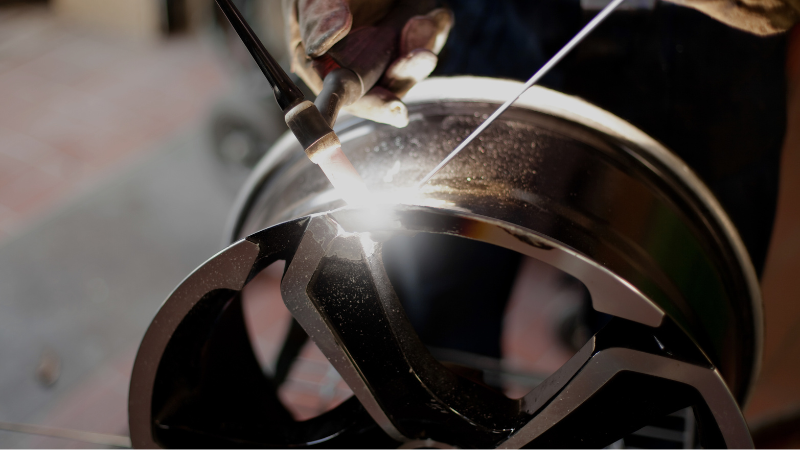
Long gone are the days when you used to buy car wheels only because they had strong mechanical properties.
Now you have to consider their aesthetic profile, tire compatibility, and weight. Flow forming marries the best traits of traditional wheels with the aesthetic appeal of modern wheels and rims.
What is the Flow Forming Process
Flow forming is a metal processing technique invented in the 1950’s that exerts pressure on your blank while spinning it thus forcing it to yield to your mandrel’s form. Its precision and cost-effectiveness have seen it gain massive popularity in wheel manufacturing.

Advantages of Flow-Formed Wheels
Having wheel that set you up for a peak driving experience while making your car look stunning is everyone’s dream. Flow-formed wheels guarantee you this. They promise a range of rewards including:
- More Strength, Less Weight: Despite weighing comparatively less, these wheels boast immense strength.
- Cost-Effective: They are smart, longtime investments since they hardly wear out.
- Improved Performance: Their lighter weight means less stress on your car’s suspensions. This translates into an even better driving experience.
- Fuel Efficiency: Their smoothness and lightweight reduce air resistance, meaning your car is more responsive. This saves you gas.
- Improved Aesthetics: You can choose from a wide range of unique geometries and finishes making your car eye-catching.
- Improved Heat Dissipation: They are treated to handle and manage thermal elements like heat efficiently and competently.
- More Durable: They are more adept at enduring fatigue making them extremely durable.
Flow Forming Wheels Process
Over the years, car rims and wheelshave been manufactured using distinct technologies but none has stood out as much as flow forming. This game-changing process found a way to blend the best of two worlds.
It incorporates the cost-effectiveness of casting and the precision of forging to produce stronger wheels with relatively lower weights.
But before we delve into the intricacies of this process, let us first dissect all the tooling you will require.
- Casting Mold: Flow forming commences with the casting of blanks into a base wheel. You will need a specialized mold engraved with a wheel form, which your molten alloy will assume. You can use a sand cast or a stainless steel mold.
- Furnace: First, you will need an annealing furnace, which will turn your blanks into molten alloy. Secondly, you will need a hardening furnace, which will improve the mechanical properties of your wheel after the flow-forming process.
- Mandrel: This is the component that will impart your final wheel form. It is a spherical tool that holds your wheel base as pressure is applied to it. This forces your workpiece to conform to the mandrel’s shape.
- Hydraulic Press: This component will not only provide the pressure required to force your workpiece to assume the mandrel’s shape, but it will also ensure that the pressure is evenly distributed. This will boost your wheel’s strength and avert cracking or deformation.
- Roller: The roller works hand in hand with the hydraulic press to ensure there is sufficient force to manipulate your blank’s shape into a wheel shape.
- Machining Center: To produce wheels that conform to the stipulated dimensions and finishing, you will need a machining center. This will shave off extra layers or parts from your flow-formed wheel leaving you with well-fitting and smooth wheels.

Step-by-Step Process
Pre-Processing
- This is a pivotal step that sees you prepare your manufacturing equipment and raw materials for machining. First, rigorously examine your workpieces to ascertain that they are in perfect condition. Also, inspect your equipment to determine if all components are well set up and functional.
- Then dissect your large raw material into smaller workpieces. For instance, if you are using aluminum, cut it into smaller aluminum blocks. Do not make the blocks too small or large, since this will either lead to wastage or smaller wheels.
- Consequently, clean your dissected workpieces to flush off dirt and other impurities that may interfere with the flow-forming process or the quality of your finished wheels.
Casting
- Once you are satisfied with the quality, state, and size of your aluminum blocks, feed them into a furnace and turn up the heat. At approximately 650°C – 750°C, your aluminum will start melting. Once it is fully molten, feed it into your designated molds at a relatively slow pace. Being hasty and careless at this stage could lead to accidents and imperfections.
- After filling the cavities on your molds to the brim, let the liquid aluminum settle down and cool off. This will take some time. Alternatively, you can exploit a cooling mechanism to hasten the process. This will lead to the solidification of your liquid alloy in a form that resembles your mold’s cavities.
- Then, extract your roughly shaped wheels from the respective molds. Be extra careful to prevent damaging the casted wheels or your molds.
Heating
After concluding the casting process, take your cast wheels and feed them into an annealing furnace. Heat them until they become softer. This will make it possible for you to manipulate their shape and form easily. Adhere to the temperature limit applicant to your specific aluminum alloy.
Forming
- Now, transfer your heated blanks into your respective mandrels and position them perfectly. Consequently, the mandrel will start spinning due to the rotation of a spindle. As the blanks spin at the hands of your mandrels, hydraulic rollers are lowered to them.
- Make certain your rollers are well positioned to ensure that they distribute the pressure uniformly. As the rollers press your blanks, these blanks will start conforming to the mandrel’s shape and form. However, you must keenly regulate the rollers’ pressure to avoid deforming your preforms. To ensure utmost forming, you can subject your blanks to several roller passes.
Cooling
Once you are convinced the preforms have conformed to the mandrels’ form, halt the rotating and the hydraulic press action. Give the resulting wheels sufficient time to cool off before extracting them from the mandrels.
Trimming
Now take your resulting flow-formed wheel wheels and load them carefully into your machining center. Instruct the machine to cut out any unwanted portions from the wheels. This will ensure that your finished wheels have the right wall thinness and diameter.
Finishing
After you have trimmed the size of your flow-formed wheels into the required size, offload them from your machining center. Analyze their condition and properties to determine if they are up to the required standard. If not, get ready to undertake the following surface treatment operations;
- Powder Coating: If your wheels fail the corrosion resistance test or you are dissatisfied with their appearance, you can powder coat them. This dry coating will revamp their appearance, improve their rust protection, and elongate their lifespans.
- Chrome Plating: This is the perfect surface treatment, especially when you are looking to make your flow-formed wheels appear luxurious and shiny. Chrome plating will also increase your wheels’ scratch resistance.
- Ceramic Coating: If your flow-formed wheel wheels are easily scratched, you should consider ceramic coating. This will make their exterior hard and almost impossible to scratch. It will also enhance their shine and boost their rust endurance.
- Electrophoretic Deposition: To make your wheels suitable for tough rides or conditions, you can utilize EPD. This finishing technique will paint or coat your wheelss black using electrical currents. As such, your wheels will demonstrate excellent wear resistance as well as strong corrosion resistance.
Inspection
Now, rigorously examine your finished flow-formed wheels to ascertain that they meet or exceed the stipulated quality thresholds. Are their dimensions accurate? Do they feature any cracks or are they deformed? Discard any wheel with defects and prepare the rest for distribution.

Common Uses of Flow-Formed Wheels
Flow-formed wheels boast numerous qualities that you are likely to miss in other types of wheels. As such, they are subject to enormous demand. Their use transcends;
- Racing Cars: They are proven to have relatively low weight, making them ideal for enhancing the handling of racing cars.
- Sports Cars: Their shiny and appealing appearance combined with their high-performance attributes has seen sports car lovers embrace them extensively.
- SUVs: They offer better traction, making them perfect for SUVs.
- Trucks: Their strength means they can easily handle rough terrains and heavy loads hence they are widely deployed in trucks and other off-road vehicles.
- Luxury Vehicles: They elevate general car performance and add a touch of elegance hence they are popular among luxury car drivers.
- Vans: Flow-formed wheels are revered among commercial car drivers and owners due to their energy efficiency benefits.
Conclusion
Clearly, flow forming is an effective and reliable technique you can use to manufacture different types of wheels. At Hautom, we will advise you on the right manufacturing technology for your wheels.
For any inquiries about Hautom flow formed wheels, contact us now.
More related information;
Forged vs. Alloy Wheels – Source: HAUTOM
Forged Wheels vs. Cast Wheels – Source: HAUTOM
Rotary Forged Wheels – Source: HAUTOM